
What’s Growing in Your Compassionate Systems Work?
Update from Ana Gonçalves, Master Practitioner Class of 2021 – Dresden International School, Germany
I led two retreat days with two different teams: our Wellbeing Team, responsible for developing and planning the wellbeing curriculum, and our Academic Team, comprising the IB Middle Years Programme Coordinator and Diploma Programme Coordinator, who work collaboratively on curriculum development.
I designed both retreat days to create space for emergence, self-awareness, and collective thinking, intentionally moving participants from the “I” to the “we.” Rather than beginning with a fixed agenda and predetermined outcomes, the structure allowed ideas and priorities to emerge through reflection, dialogue, and shared sense-making. I drew on Otto Scharmer’s Theory U to shape the overall flow, moving participants through processes of connecting with themselves, observing and listening, developing shared understanding, and identifying meaningful next steps.
The day began with a check-in, using the small-group check-in protocol from the Center for Systems Awareness, to create a sense of presence and connection before moving into the work. This was followed by Look – Sound – Feel, a reflective protocol that encouraged participants to observe their current reality from different perspectives and articulate what they were noticing. The routine was informed by approaches such as Harvard’s Project Zero Thinking Routines, including See, Think, Wonder and Think, Feel, Care.
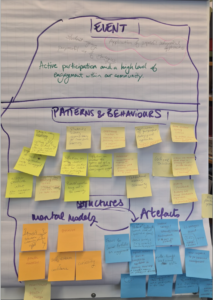
We then used the Aspirational Iceberg, drawing on resources from the Center for Systems Awareness, as a way of imagining and articulating the future we wanted to create. Rather than analysing the current reality, the activity invited participants to begin with the event they hoped to see and then explore what would need to exist beneath the surface to make that future possible. This encouraged participants to think beyond immediate actions and consider the relationships, structures, values, beliefs, and ways of working that could help bring their shared aspirations to life. In this way, the activity helped shift the conversation from what is towards what could be and supported movement from individual aspirations towards a shared vision.
The 5 Ws & H – Who, What, Where, When, Why and How – provided a further structure for making sense of the ideas that emerged throughout the day. This helped move the groups from exploration towards greater clarity, allowing them to identify priorities, consider context, and begin translating their thinking into possible directions for action.
The retreat concluded with individual and collective reflection questions, followed by identifying the next three immediate steps. Each step was captured using one action word. This was deliberate: after a full day of exploration and ideation, the intention was to sustain energy and momentum by keeping the focus on what could realistically happen next, rather than becoming overwhelmed by longer-term possibilities.
Overall, the retreat design sought to balance reflection and action, individual awareness and collective purpose, and emergence with intentionality. The combination of Theory U and reflective and systems-thinking protocols created a structure within which both teams could pause, listen, make meaning together, imagine a shared future, and move towards concrete next steps. This approach also created space for different perspectives to surface, allowing each team to build greater ownership of its shared direction.
Update from John David, Master Practitioner Class of 2024 – Tulare County Office of Education, California, USA
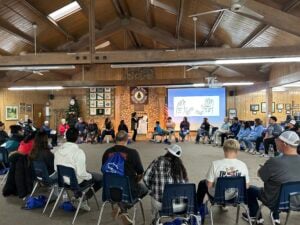
It was the moment I knew the work was making a difference. At a regular monthly check-in, our county office Community Schools Coordinator asked a school leader the simplest question: “So, how’s it going?” After a slight pause, the leader breathed a heavy sigh, “I think we are spending too much time in our current reality and not enough on our vision.” Following the COVID pandemic school closures, California made a four billion dollar Community Schools investment to change the way we do school and address the profound needs of our most underserved students. The Community Schools model had been used in other places, such as New York City schools, with measurable success but had only limited implementation in California. In Tulare County, our home in the rural, agricultural, and immigrant rich Central Valley, Community Schools was a new idea.
When the California legislature first funded the program and a state center to develop the California Community Schools Framework, I was asked to be our County Lead. Near the same time, I began a year in Cohort 5 of the Compassionate Systems Master Practitioner Certification Program. Very quickly, the connections became clear: Healing the wounds that divide so many families and communities from their neighborhood schools required an interconnected, relational, systems approach. The potential of Community Schools could be realized through a Compassionate Systems frame that emphasized systems thinking as well as systems sensing.
Thus, to support 24 school districts and 107 schools across 5,000 square miles of Tulare County, our small but mighty Community Schools team made extensive use of the Compassionate Systems tools. First, we adopted an opening ritual with regular groundings and check-ins. Leading with awareness and intentionality, unmistakable transitions began to take place in the leaders we serve as well as within our county office. Being present and honoring each others’ humanity has become how we do business.
Next, with the goal of implementing one tool consistently county-wide, we let the best first tool emerge by using many of the tools on ourselves as a department. Eventually, our Community Schools team chose the Creative Tension Tool to share. Our team meetings, community of practice, and regular professional learning offerings centered on the tool. We taught it even as we continued to be learners ourselves – sometimes awkward, definitely imperfect, but always with a desire to learn together. Most importantly, our regular monthly check-ins with the school leaders we support became anchored in the creative tension model. What is your current reality? What do you want to create? Where are you finding tension? For more than a year, we provided the prompts. Then something changed. No longer needing to teach the model, our role became simply establishing the reflective space. The dialogue emerged naturally. A mentor and friend of mine once told me, “You cannot make tomatoes grow by yelling at them.” There are certainly times of impatience and discouragement. Through nurture and care, consistency and intentionality, however, the fruit of real systems change is growing in our county and many places throughout California.
Update from Aralbek Berikuly, Master Practitioner-in-Training – Ybyrai Mektebi School, Kazakhstan
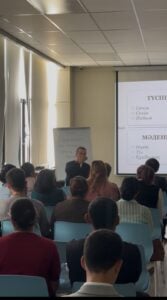 We brought together around 50 teachers from rural schools across Samar District for an afternoon of professional learning with Eskendir Bestay, a well-known Kazakhstani educator and teacher trainer. He led two two-hour sessions: “Learning How to Learn” and “The Mission of a Teacher.”
What was particularly meaningful for me was that this was not meant to be a one-time event. It is part of the Samar Teacher Growth Network (STGN) that we are currently building. Our intention is to bring rural teachers together regularly and gradually develop a professional learning community around them.
We are planning to invite different experts each month to explore areas that influence both teaching and human development – including how the brain learns, pedagogy, emotional intelligence, sleep and nutrition, physical well-being, talents and habits, school culture, classroom management, reading culture, questioning, assessment, and theory of change.
As STGN is still taking shape, I am also beginning to think more intentionally about how we can embed Compassionate Systems Awareness into the way this community develops – not simply bringing knowledge to teachers, but creating conditions in which they can learn together, reflect, build relationships, and gradually develop their own capacity for continuous improvement.
See list of all Articles